Showing posts with label teaching. Show all posts

Monday, April 18, 2016

Best and worst teaching moment

In my latest leadership team meeting at school we were asked to reflect on our very best and very worst teaching moments. What moment made me feel awesome and that I was born for this? What moment made me feel like a total failure?

I had a very easy time thinking up terrible moments. They all came from my first 3 years teaching and they all involve me yelling. It's not that I don't yell at some kids now... every once in a while. It's that I make a choice to yell or raise my voice. I use is strategically now. In the past this wasn't always the case. 

I don't want to bore you with the exact situations, but there were a few moments from my early teaching days that my anger and frustration burst forward like a dam giving way the inevitable force of massive amounts of water. When I think of those times it's like I'm watching a movie about someone else, but I can still physically feel my rage. I am in no way proud of them. It brings feelings of embarrassment and shame. I want to chalk it up to my inadequacies as a new teacher. Fact is, though, the problem wasn't being a new teacher. It was being a new adult. I was not in control of myself as much as I wanted to be. I don't want to make it seem that I was yelling and screaming all the time. I had some very good times... But those moments of totally losing my cool have stayed with me like scars. They are reminders of my past failures. I can do better and have since. There's no advice I can give a new teacher to through these times other than to take deep breathes or even leave the room if you have to as I have done recently. But, as I said, it's not a teaching problem. I think it's an adult problem. I think being a new teacher is hard anyways, but stack on top of it figuring out how to be an adult out of college... it makes it much worse. Your anxiety about paying bills, and getting groceries, and starting a life seep into the classroom... just like it does for kids. 


Sadly, when I tried to think of an exact moment when I knew I was born to teach, I couldn't think of one specifically. I can think of kids who went on to be successful in art, but I'm not sure it was due to me. Instead of one big moment, my successes are built from tons of little tiny moments you don't realize are important until later. 

There were tons of moments that flashed through my head of sitting and helping a kid think though a project idea and coming up with something that made their whole body light up. Or when you push them a little harder and they exclaim at something awesome they just did. When they can't wait to show you what they did. When they bring in work from home that blows you away. When they come to your room everyday during lunch to make art because it's there favorite place in the world.

I don't want it to sound like this is my whole day. I'm not that teacher. I'm not the worst, but I'm far from the best. But I have little, tiny moments frequently that seem to reaffirm what I'm doing.

In teaching, often times the days are hard. You go home thinking of that one kid who threw clay, or the kid whose project broke, or the kid who just has given up. Those kids make it hard. Not because they are that awful but because you actually care. But there are so many successes we don't think of day to day. While I was unable to think of one example of why I was meant to teach, there is a body of work that keeps me coming everyday.

Sorry if this was too sappy. Its just a reflection. 

Monday, March 28, 2016

Art Teaching Philosophy

I recently applied for an Adjunct Professor job at a local community college. Its for Art Appreciation and Art History. It took me much longer than I thought to rework my resume or CV (which I had to look up). I then had to write an Online Teaching Philosophy Statement. That turned out to be quite difficult. I found some good examples online, though, and finally created it. The way that worked for me was to just forget about all the formal stuff and examples and just sit down and write my real thoughts and feelings about my teaching philosophy, blast them all out, then go back modify. I won't go into how to write one here. I'm not at a level where I can teach others to do it, or how to write a resume, or get a job. I can just share what I wrote and how I did it and hope it helps me get the job. I'll let you know.


TEACHING PHILOSOPHY


I want to share my passion for Art and for learning in a way that will encourage and help my students in the present and have positive if not profound affects on them for the future, allowing students to find connections to other artistic avenues and endeavors as well as to the greater world itself.

In my experiences in undergraduate studies, I had a handful of amazing professors and mentors that not only pushed me to work harder and smarter, but also the importance of putting in the time and investing myself into my Art and my teaching. I learned how to see artistic opportunities and possible art lessons in everything around me. I learned to see how everything was or could be connected inside and out of the Artistic world. In my travels and studies I met many amazing artists and educators that showed me how an interest in microbiology could lead to a living biome as an amazing work of art or how an interest in Baroque architecture could help lead to an innovation in contemporary stained glass technique. These are the types of work ethics and connections I want to share with my students. Its what I try to do in my classroom everyday.

There are many roads and paths one can take to achieve these goals. There are countless, infinite, examples to Art to gaze upon, dissect, and use as catalysts to new realizations, connections, and discussions. I want my students to not only come away with the learning and skills that come from rigorous work in writing, reflection, and collaborative conversations. I want my students to come away with a sense of how Art is connected to the world around us, past and present. I want them to discover how art shapes our society and vice versa, how it reflects our recent and ancient pasts, and how it might help create or be created by the next chapter in human history. I think the question of, “What does Art have to do with me?” is on too much of a micro scale. I believe we need to ask more questions in the macro scale.

I believe that through the use of important and significant Art examples, engaging discussion questions, compelling peer conversation, and challenging but purposeful projects, I can help my students make gains in their understanding of Art and in their critical thinking abilities. In my class you would see students breaking down works of art through the formal steps of Art Criticism. You’d also see my students using that information to see how that work of art fits into its time and space and how we may use that information in a more contemporary context. You would see students challenging conventional ideas about what they may have been taught about art, challenging each other’s ideas, and hopefully challenging my own, allowing us all to learn and grow in knowledge together.


Thursday, February 11, 2016

Art Lesson: Clay Spirit Animal Vessels

This is a lesson I have taught a few different ways, but the way I've done it the past few times seems to be the way to go... for me at least. I usually teach this to 7th graders, but it would work well for other levels as well. I wont go into complete detail, because that's boring. Plus, if you want to use this lesson or send it to someone who does, they will teach it their own way and style anyways. You can translate any of this into almost any material you wanted, especially the first part of the unit, which is 2D instead of 3D.


To start the lesson I introduce the students to the idea of Spirit Animals. We don't go too far down the rabbit hole with this, but keep it light and fun. We actually watch an episode of Rob Dydrek's Fantasy Factory, (Season 1, Episode 2), where he brings in a Shaman to find his Spirit/Power Animal before taking a big rally car jump. Its fun and gets good buy in. I tell the students their homework is to find their spirit animal. They can do this through thought or taking an online test, etc.

Wouldn't this be a great T-shirt?
The next couple days we spend in the computer lab finding images that will help us draw and sculpt the animal. Not only do I encourage them to find images to print on a PowerPoint slide that are realistic and from different angles, but I encourage them to add words to their search to find other versions of their animal that might help them. For example, my animal was a fox. I searched "fox mascot", "fox sculpture", "fox cartoon", and "how to draw a fox". This last search will not only help with drawing, but also with sculpting as the steps can be the same if you translate shapes into forms.

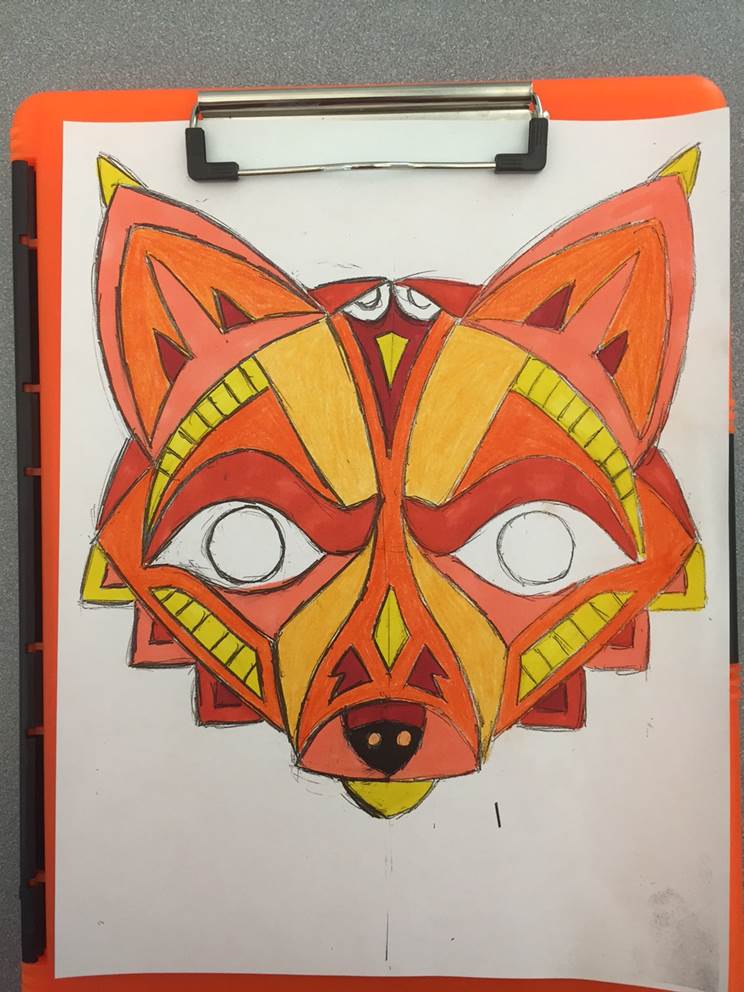
In my latest version of this unit I introduce the kids to Haida Native American art work, especially their work with animals. We discuss symmetry, use of simplified organic and geometric design, hidden faces in the designs, use of common motifs, etc. I then have the students use their research to help them draw out half their animal, fill it in with similar design styles to the Haida (but not direct copies, more focusing on creating geometric and simplified organic designs), and then trace or transfer the half drawing onto the other side of the paper. I allow them to color these in with Sharpies, colored pencils, etc.


Its a good lesson, especially to start a semester. My examples, step by step, are below, but the kids did a lot of great examples... I included a few of those as well.


Once this project was over, we revisited the idea of a spirit animal. I then went over the requirements and examples for the next project.... the clay vessel project. This is a long term project that teaches a lot of skills. I come in to this lesson, though, knowing I have taught many of them how to make pinch pots, coils, and use slabs in 6th grade. As I stated earlier, I don't want to get too into details, so I will try to keep these descriptions of what we did simple.

The requirements of this lesson are the following; The vessels must:
  • Be built using pinch pots and coils
  • Have a lid (cut out from vessel)
  • Include additive, subtractive, and incising techniques
  • Include a sculpted animal
Within this structure I do allow quite a bit of freedom, but those are the basic skills I look for. Once we go over these requirements, we spend some time brainstorming as a class. I find it very helpful to show them how to do this. We pick an animal and then make lists or word webs to find ideas and objects we can use in our designs for the vessel.  Then I sketch it out in front of them, tossing around tons of ideas. Once we've done this together, I release them to sketch on their own.

Before we make the project, I spend some time having the students practice. I demonstrate techniques and ideas, then they practice with the clay for the day. One day we use a "how to draw animals" book. I allow a student to choose one and we then all go through the steps all together, sculpting the animal, discussing issues and techniques, etc. I demonstrate this on the projector screen using the document camera while they work on their own versions individually along with me. Another day I demonstrate pinch pots and have them practice these for a day. These are good warm ups, skill builders, and allow them to work free of pressure for a day.

After practicing, we get right into the project. The way I have them build their vessels is a little different, but works really well. BUT, if you want to use this, build them however you want. I have the students start with a pinch pot and build up with coils to desired height and form. Once this is achieved, we create a slab, flip the vessel over, trace the opening onto the slab, and attach it. This is now the bottom. The pinch pot is the top. The reason I do this is it helps later with cutting out the lid. You could just keep the slab on top and cut the lid out. Whatever works better for the students design, really.

The rest of the project is mostly technical details, but below are the individual pages from the packet I hand-made for the students. The first images are the examples I made for this project.If this is helpful to anyone, good. Otherwise, I hope you enjoyed the images.


Sunday, December 20, 2015

Snap Judgements and Instincts

I just read the book Blink by Malcolm Gladwell. You may have heard of this author from his other books, like Outlier or The Tipping Point. This book is all about our innate abilities to make judgements based first impressions and instinct. Actually, that is simplifying things a little, but thats essentially the idea.


There's tons of great examples in the book about how "thin-slicing" people and situations can allow us to make the same or even better ideas than "thick-slicing". In one example, people were asked to assess and judge the effectiveness and abilities of a professor based on a 2 second clips of them teaching. This seems ridiculous, but most of the participants in the study, something like 80% of them, were able to assess them close to the professor's actual assessment by the university. In 2 seconds, people were able to tell if the professor's were good or bad at what they do. Why? That's the mystery to book looks into uncovering.

I'm not here to write a review of the book, but it is very good if you are looking for some very interesting information and studies. The idea of this book is more interesting to me.

Everyone at one time or another has come across a time or situation where you just have a feeling about what you should do. Everyone has met someone at one time or another and decided very quickly if you liked this person or not, but then are often left wondering why we felt this way.

We tell kids all the time when taking a test, that their first impression of the answer is probably the correct one. But, we also teach them critical thinking. We teach kids that, when they come across a situation, that they should think it through thoroughly before acting. That seems like the best way to approach anything, really. But the information presented in this book makes me think that its possible that its not... that maybe we should be working and processing more based our instincts and snap judgements. MOST (but not all) of the time, these decisions are just as good or better than the decisions we make when thinking it through and weighing every piece of information. Perhaps we should be teaching kids to hone their instinct and gut judgements. Not that they shouldn't learn all they can to make informed decisions, but that they should take that information they have learned and trust their judgements and instincts.

For example, think about a sport like basketball. I wouldn't expect 14 year old to make the right play and/or decision all the time while playing. In basketball, one has to make lots of decisions and make them in quick succession. It would be difficult for someone young and newer to the game to make the right decision in a split second all the time. BUT, after someone has spent a few years practicing and playing, these decisions come easier and faster. The more you practice and play the game, the more scenarios and situations you have come across. The more your practice and play, the more physically able you are to follow through on your decisions. If you have played, think about a time where you were playing someone one-on-one. I can think of many. One in particular comes to mind.

I was in 8th grade and we were playing another undefeated team. They had a really big kid on their team same Steve Young. He had a damn beard... seriously. He was very big for his age, but that meant I was quicker and faster (being our center, but being only 5'8" and skinny), which was true, but also made me feel better to tell myself. My coach told me to call for an isolation play if he guarded me one-on-one so I could dribble past him for a lay-up. In the last moments of the game it was tied and we had the ball with a chance to win. Our coach had called a play for a screen to get the ball to our best shooter and have him take a shot. I noticed, though, that they were in a man-to-man. I told everyone to change the play and held up the signal for an isolation play for me. I got some questionable looks form my teammates, but I was so confident (for no reason), no one questioned it. I got the ball off the inbounds, everyone cleared out... I took Steve Young on, skinny young man against man-child. I drove him to the free throw line... stopped... pulled up... and launched a shot. I heard my coach yelling, "Nooooooo!", which amazingly turned into more of a "Noooooeeeeyaaaaah!" because I swished the basket at the buzzer. We won!

This picture seems to sum up what middle school basketball is like

I realize that this story may not be as exciting for you, but there's a point. How did I know exactly when to stop and shoot? There was no play or plan. The plan was, take him one-on-one. In that moment, though, I didn't think... I reacted. Thats a normal idea in sports, right? You react. But, how do we know when and how to react best. I had played enough one-on-one at the YMCA and in my backyard and on the playground to know when I had enough space to pull up and take a good shot. As the situation developed, by learned instincts kicked in and I made the play. Even if I had missed, it would still have been a good, open shot. The key words, I think, though, is LEARNED instinct. We train for this in sports all the time. You practice and train your instinct and judgments. Maybe we should spend more time doing this in our everyday lives?

In the book, Gladwell brings up a comparison between military personnel and stock market traders, and it makes complete sense. These traders are making tons of decisions on, what seems like, very little information. They have "hunches" or "feelings" about what to do and when to do it. Thats not to say, though, that they they are guessing. They study trends and analytics all the time. But, when its time to trade, they use their instincts and judgement, trusting that what they have learned and studied will kick in. If they spent all their time trying to think their trades through critically, they would miss everything.

I know I tie in a lot of my ideas to school and education, but its the world I live in.... I think this idea of preparing ourselves better in order to make smarter "snap judgements" or improve our instincts is a very interesting one. What if we took that approach in the education system and when teaching? We told the kids, "Hey, I don't know when you will need this information, but at some point you might. When that time comes, you can trust you know what to do and can  trust your judgement and instincts  and make a decision. Thats why we are learning all of this. So that when you are out there, in the real world, you can trust yourself to make good decisions based on your initial reactions." Personally, that  approach sounds more exciting to me than trying to learn chemistry and ecosystems just because the textbooks says I need to know it. I think it would feel like you are actually training and preparing for something.

There are so many situations I can think of where having the ability to make a good, quick decision, would be so helpful and that overanalyzing makes things worse. If I felt like I was more knowledgeable on a subject, though, I think these situations would be much, much easier.


One example I can think of was when my wife and I were trying to buy a house. We looked at well over 100 houses and looked for months. The market was crazy and the economy had crashed, so cost was low, but our salaries were also frozen indefinitely. It made things a little more complicated, in our minds, to choose. In one house we put an offer on, we were actually under contract for a month before the deal went under. The whole time I remember not having a great feeling about it, but thought I was just nervous abut a house in general. But maybe my instincts were kicking in to tell me it wasn't good. On another house I saw what knowledge and expertise combined with snap judgements and instincts can do. My wife and I liked the house were looking at with our realtor's partner. Our realtor is an amazing dude, but couldn't make it to the house to show it, so his very capable partner came to show it. The layout was good, price was decent, location was nice, etc. We were starting to get desperate to find something, so our judgement was suspect. In the unfinished basement, we noticed two sub-pumps. Whatever...right? We were ready to put an offer down and we called our main realtor to tell him. His partner explained the house and the price and casually mentioned the two sub-pumps in the basement. I remember hearing our realtor on the other line go, "Wait! Two sub-pumps? Hmmm... I don't like that.... I driving up." A 45 minute drive for him later, he burst into the house, said a brief hello, and started sniffing around like a drug dog looking for a hidden stash. He started in the basement, saw the pumps, and grunted...not happy. Then stared at the cement walls int he basement, made more faces and grunts, then headed up stairs. He felt the tops of the doors and then looked like someone who found the remote control in the couch after looking for it for so long. "This house has foundation problems, don't buy it". There were fixed cracks in the foundations concrete. The tops of the doors had been sanded to fit after everything had shifted. The multiple sub-pumps were to deal with regular flooding. All this makes sense... but he drove 45 minutes on a week night, late, based on a casual piece of info about 2 sub-pumps. He knew instantly something was wrong, and he was totally right. His well informed instincts told him this was a bad house. He didn't need time on the phone to talk about what could maybe be wrong. He felt it was wrong and immediately headed put to see us. That ability, though, came from years of experience seeing thousands and thousands of houses. Now, maybe someone off the street might be able to come in and make the same decision based on instinct, but his instinct were informed.

What if we taught kids this way? Learn so you are prepared. Learn so you are ready when you need to be. When they get a to a test, we would tell them to trust their instincts and judgements. Read the questions through, jot down notes or numbers if needed but trust the answer you initially believe is correct. If they paid attention and learned throughout their classes, their instincts should serve them well when testing. If we teach them well, in the real world they should be able to make good decisions faster and more frequently as they will be able to trust their instincts.


I do teach this some in my art class. I tell kids, in order to check their work, have someone hold it up from a distance. But I tell them to close their eyes first, then open them and decide upon first look whats right and whats wrong with the work. Their initial judgements should help them in creating better work. I teach this as almost a trick, but now I am thinking I need to teach it as a real and useful tool. There's this big emphasis on art critiques and the steps one needs to take when critiquing a work of art. I get why and I think the thinking behind it is valuable, but maybe instead of teaching it to be repeated, I should really be teaching it so they don't have to do it anymore and tell them that. "If we can get good at this is as a class using the formal critique steps, then we can et rid of the steps and the writing and have conversations based on how you feel about the work." Doesn't that sound like a more fun way to live, anyway?